What happens if you invest $100 every month? You contribute $1,200 in a year, $12,000 in a decade, and $36,000 over 30 years. If those contributions earn positive investment returns over time, the account can grow beyond the money you put in. But markets are unpredictable: the investment balance can also fall, and none of the projected returns below is guaranteed.
For a beginner, investing $100 monthly can be a useful habit because it makes long-term investing approachable without needing a large starting balance. The right choice still depends on your emergency savings, high-interest debt, goals, risk tolerance and access to investment accounts. This guide explains the numbers, the trade-offs, and a realistic path to getting started.
Quick answer: How much can $100 a month grow?
These scenarios assume you invest $100 at the end of every month, start at $0, and receive a constant hypothetical annual return compounded monthly. There are no fees, taxes, withdrawals, or interruptions, and the figures are in US dollars. Real market returns fluctuate and may be negative.
| Years | Your deposits | At 3% | At 5% | At 7% |
|---|---|---|---|---|
| 5 | $6,000 | $6,465 | $6,801 | $7,159 |
| 10 | $12,000 | $13,974 | $15,528 | $17,308 |
| 20 | $24,000 | $32,830 | $41,103 | $52,093 |
| 30 | $36,000 | $58,274 | $83,226 | $121,997 |
| 40 | $48,000 | $92,606 | $152,602 | $262,481 |
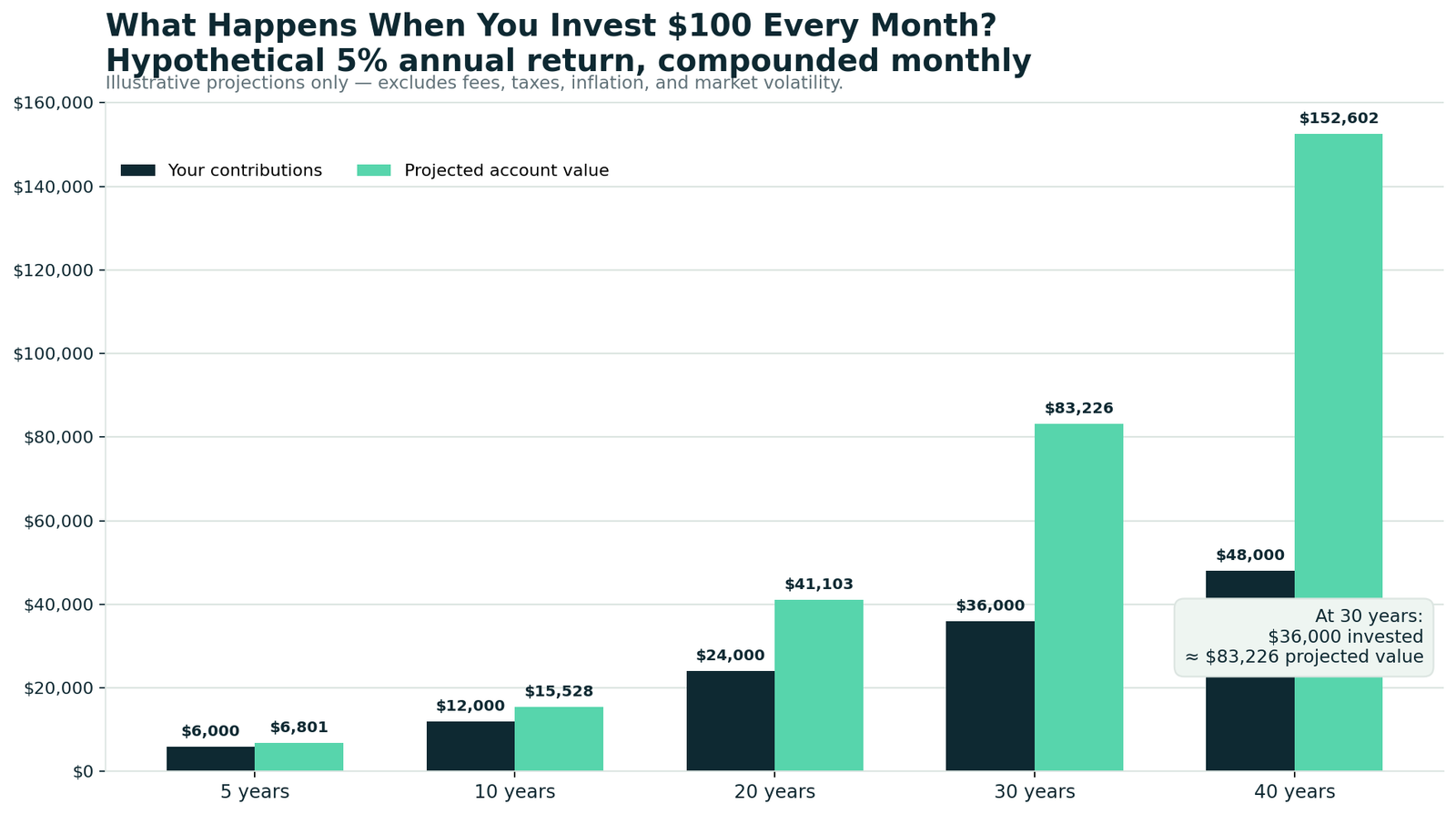
What the table really says: At an assumed 5% return, $100 monthly could become about $83,226 after 30 years. You contributed only $36,000; the other approximately $47,226 represents modeled investment growth. If future returns are lower, your balance can be considerably smaller. At a loss-making sequence of returns, you could finish with less than your total deposits.
This is a mathematical illustration, not a promise or forecast. Explore your own assumptions using our compound growth calculator and the SEC Investor.gov compound interest calculator.
1. What actually happens to your first $100?
When you put $100 into an investment account and purchase shares of an investment, you exchange cash for an asset. Its price can go up or down. Depending on the investment, you may also receive dividends or interest, which can potentially be reinvested. A brokerage account is a place to hold investments; it is not itself a guaranteed-return product.
Suppose one share costs $25: $100 would purchase four shares, before fees. If its price instead costs $20 next month, the same contribution would buy five shares. If it climbs to $50, that $100 buys two. In a diversified fund, the process is similar, although fractional shares, fund mechanics and fees differ by provider.
Buying on a regular schedule can help build discipline. It does not protect you against a falling market or make poor investments safe.
2. Why time matters more than the first contribution
The first few years often look underwhelming because contributions make up most of the account. Under a hypothetical 5% rate, five years of $100 monthly deposits produces about $6,801—only $801 above the $6,000 you contributed. After 30 years, the same schedule produces about $83,226, with modeled growth greater than the amount contributed.
This is compound growth: investment gains potentially produce gains of their own when retained or reinvested. The SEC's investing introduction explains why regular contributions and a long time horizon can be powerful in building wealth. It also stresses that investments carry risk.
Starting earlier provides more potential compounding periods, but no age guarantees a result. Even starting later, consistency and choosing affordable contributions can support long-term goals.

3. What is dollar-cost averaging?
Investing a fixed amount on a regular schedule—such as $100 on payday each month—is commonly called dollar-cost averaging. When prices are lower, the same amount can buy more shares; when prices are higher, it buys fewer. The routine can reduce the temptation to guess which market day is best.
There is an important distinction: investing $100 as you earn it is different from holding a $12,000 lump sum in cash and delaying its investment over a year. For an available lump sum, gradual investing may reduce short-term downside exposure but can sacrifice gains if markets rise during the delay. It also cannot guarantee a profit. Learn more from Investor.gov and FINRA's explanation of the benefits and limitations.
4. How fees can change the result
Investment platforms and funds may charge expense ratios, account fees, spreads, commissions, or other charges. A seemingly small percentage can matter over decades. For example, an investment earning 6% before a hypothetical 1% annual expense drag might net roughly 5% before other costs and taxes. The difference between modeled 6% and 5% outcomes compounds with time.
Compare the full cost of the account and investment, not merely the price of buying one share. Flat monthly fees are especially worth examining on very small accounts. A $3 monthly subscription is $36 per year—already 3% of $1,200 in annual contributions, even before other costs. That is a ratio of fees to contributions, not an investment fee rate.
5. Inflation means future dollars buy less
A future account balance is not the same as future purchasing power. If inflation averaged a hypothetical 2.5% per year for 30 years, $83,226 in future dollars would have purchasing power equivalent to roughly $39,700 in today's dollars. That calculation divides the future amount by 1.025 raised to the 30th power; it is another scenario, not an inflation forecast.
Investment decisions should account for how far away a goal is, possible market losses, and inflation—not just a large future-value number.
6. What could a beginner invest $100 in?
There is no investment product suitable for everyone. Some people compare low-cost, broadly diversified index mutual funds or exchange-traded funds (ETFs), while others have access to employer-sponsored retirement plans or other locally regulated accounts. Diversification spreads exposure across multiple holdings, but it cannot eliminate market risk.
Before choosing, check whether the account or provider is appropriately regulated in your country, understand any minimum contributions, taxes, currency-conversion costs, and withdrawal restrictions, and read the fund's prospectus or key information document. Avoid buying an asset just because an influencer says it will rise. Never assume a company or investment product is protected against loss simply because an app looks professional.
If your goal is within the next year or two, a cash savings product may fit better than volatile investments. Our save-or-invest guide discusses the difference.

7. What should come before investing $100 monthly?
First, cover essentials and minimum payments. Do not invest funds needed for rent, food, transport or required bills. If you carry high-interest credit-card debt, paying it down may offer a more dependable financial benefit than pursuing uncertain market gains.
Second, build an emergency buffer. Unexpected medical, household, job or car expenses can force people to sell investments at an unfavorable time. Keep an appropriate cash reserve accessible for emergencies. You can start with our first emergency fund guide.
Third, consider employer benefits and your financial situation. Where available, employer retirement contribution matches can be valuable, but eligibility and withdrawal rules vary. The SEC recommends controlling expensive debt, building an emergency fund and investing regularly when feasible.
8. A practical monthly $100 investing routine
- Choose a goal. Retirement, long-term education or another goal with a time horizon that makes investing appropriate.
- Confirm affordability. Review your monthly take-home income, required bills, emergency savings and high-interest debt.
- Research account options. Compare regulation, available investments, diversification, fund expenses, trading costs, tax treatment and withdrawal rules.
- Set up the routine. If suitable, automate a $100 contribution after payday; $25 weekly is a different contribution schedule and totals $1,300 across 52 weeks.
- Invest according to a plan. Choose investments that fit your goals and risk tolerance, rather than following short-term trends.
- Review periodically. Check costs, diversification and goals, but avoid reacting impulsively to every market movement.
- Increase cautiously. If your income grows and other priorities are covered, consider raising contributions without committing money you need soon.
9. What if you can only afford $25 or $50 a month?
A lower amount that you can maintain is generally more workable than an ambitious amount that causes overdrafts or unpaid bills. At the same illustrative 5% rate, the 30-year projection scales with contributions: $25 monthly grows to around $20,807, while $50 monthly grows to about $41,613. These figures are mathematical scenarios and carry the same uncertainty as the $100 example.
Focus on the behavior first: setting a goal, building emergency savings, understanding investments, and choosing a contribution that is genuinely sustainable.
10. Mistakes to avoid when investing small amounts
- Assuming a guaranteed 7% or 10% return: actual prices and returns vary.
- Ignoring fees: platform charges can consume a disproportionate share of small deposits.
- Putting emergency cash into volatile assets: you may need it precisely when prices are down.
- Chasing a single hot stock or cryptocurrency: concentration can expose you to substantial losses.
- Using borrowed money to invest: your debt remains even if the investment falls.
- Stopping solely because of a market decline: revisit your long-term plan and personal risk capacity rather than acting automatically.
- Believing all providers or products have the same protections: regulation, investor compensation rules and product risks differ across jurisdictions.
Frequently asked questions
Is investing $100 a month worth it?
It can be a meaningful long-term habit if you can afford the contributions and choose investments appropriate to your goals and risk tolerance. The outcome is uncertain, so first consider essential bills, expensive debt and emergency savings.
How much is $100 a month for 20 years?
Contributions total $24,000. Under the simplified constant-return model in this article, the projected result is about $32,830 at 3%, $41,103 at 5%, or $52,093 at 7%, before fees, taxes and inflation.
Can I become a millionaire investing $100 monthly?
There is no guaranteed timeline or return. At an assumed 7% annual rate compounded monthly, 40 years of deposits produces about $262,481, not $1 million. A higher contribution, longer time, or higher return could change a mathematical projection, but higher returns must never be treated as assured.
Is it better to invest $100 monthly or save it in the bank?
That depends on the purpose and when you'll need the money. A savings account generally suits emergency cash and near-term goals; investing may suit longer horizons where you can tolerate losses.
What happens if the market falls after I invest?
Your holdings can lose value, even after years of contributing. Continued purchases buy assets at prevailing prices, but dollar-cost averaging cannot prevent losses. Evaluate your goals, risk tolerance, costs and investment choices.
The bottom line
Investing $100 every month is less about a magic number and more about building an informed habit. Over many years, contributions can accumulate and may benefit from compounding. But investment markets do not produce smooth, certain gains. Start with affordable amounts, understand the risks, protect your near-term finances, and prioritize a plan you can sustain.
For your next step, try the SION INVESTS compound growth calculator, read compound interest explained, or explore how to build a realistic budget.